Black magic …
The Black Hairstreak Satyrium pruni is among Britain’s rarest and most elusive butterflies, quietly present, yet seldom seen. Though long overlooked due to its resemblance to its close relative the White-letter Hairstreak Satyrium w-album, it was only formally recognised in 1828. A creature of stillness rather than wander, it tends to remain rooted within a single pocket of woodland, its colonies rarely straying far even where suitable habitat lies close by. This limited dispersal, set against the slow loss and fragmentation of hedgerows and woodland edge, helps explain its enduring scarcity.
Traditionally, its British range has been closely tied to a narrow band of heavy clay soils stretching from Oxfordshire to Cambridgeshire, where Blackthorn Prunus spinosa, its larval foodplant, thrives in sheltered, sunlit margins. Yet from a Sussex perspective, the story has shifted. Once absent, the species has in recent years begun to establish a tentative presence within the county. Its arrival feels understated but significant, hinting at changing conditions, whether through climate change, introduction, or careful land management, that now allow it to take hold beyond its historic strongholds.
Its adult life is fleeting, confined to a short window from mid-June into early July, with just a single generation each year. Even at the height of its flight period, it is more often detected than observed. Adults spend much of their time high in the canopy moving quietly among the leaves. Here they feed not on flowers but primarily on aphid honeydew, glistening unseen in the summer light, though they will occasionally descend to nectar on other sweet sources.
As with all hairstreaks, its flight is quick, erratic, and easily lost against the sky. The challenge of identification is compounded by its frequent association with White-letter and Purple Hairstreaks with which it may share the same treetops. In motion, the three are almost indistinguishable, mere flickers of brown and silver, vanishing as quickly as they appear.
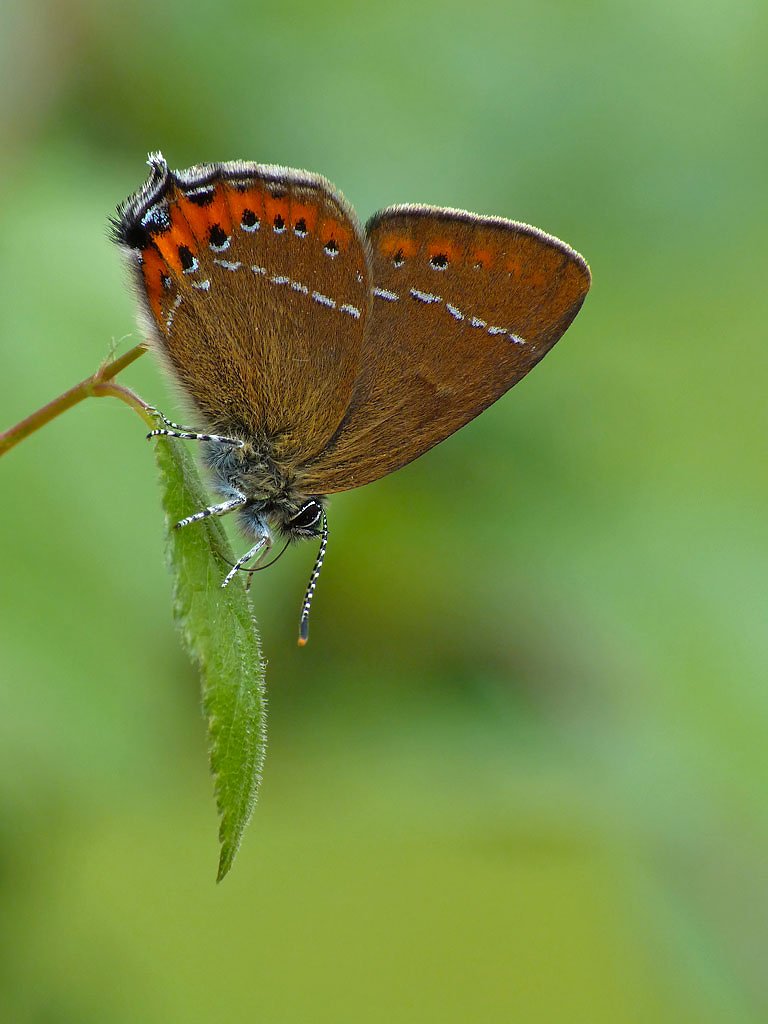
A male pictured, briefly pausing to feed, offers a rare glimpse into an otherwise hidden life.
References:
https://ukbutterflies.co.uk/species.php?species=pruni [Accessed, 7th April 2026].