Ptarmigan
Bound to the open, windswept landscapes of tundra-like environments, the Ptarmigan Lagopus muta finds its British sanctuary high in the Scottish mountains, where cold air and sparse vegetation still echo the conditions of its broader Arctic range. In the UK, the species occurs at the southernmost edge of its global distribution, with a small, fragmented population estimated at only a few thousand breeding pairs, making it one of Britain’s most specialised upland birds.
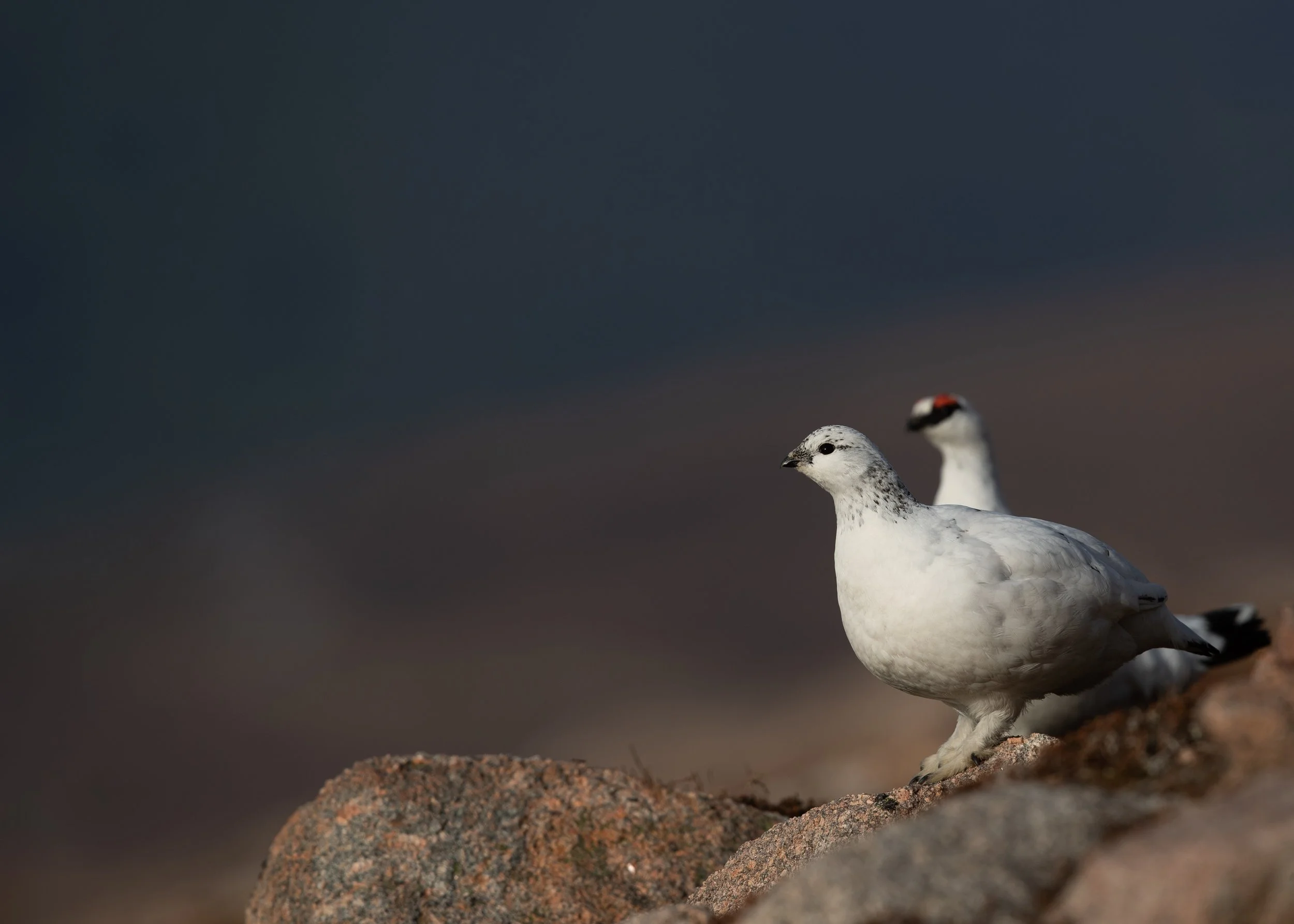
Perfectly shaped by cold, the Ptarmigan transforms with the seasons. As winter tightens its grip, dense feathers cloak its feet, spreading its weight like natural snowshoes across frozen ground, while its plumage fades to pure white, dissolving the bird into the snowy landscape. Summer brings a subtler palette: mottled browns in females and soft greys in males, mirroring the thawing rock and lichen. Living where vegetation clings lightly to the earth, Ptarmigan feed on young shoots, berries, and the brief abundance of insects that summer allows.
In the UK, the Ptarmigan is Red-listed as a Bird of Conservation Concern, reflecting a marked decline in breeding numbers and the growing pressure of climate change. As temperatures rise, the cool montane habitats it depends upon retreat ever upward, compressing the species into ever-smaller islands of suitable ground and underscoring the fragility of its future in Britain’s highest places.
Often easier to locate by sound rather than sight, the time I have spent with these beautiful birds is never enough but valued greatly. The above image, one of many, was taken late afternoon on a cold, sunny day in February 2019. My grateful thanks to good friend Andy Howard with whom I have spent many happy hours in search of these and other Highland gems.
References:
Howard, A. (2019). The Secret Life of the Cairngorms. Inverness, Sandstone Press.
https://www.andyhoward.co.uk [Accessed, 13th December 2025].
https://www.bto.org/learn/about-birds/birdfacts/ptarmigan [Accessed, 13th December 2025].