Wrinkled Peach
Rhodotus palmatus, the Wrinkled Peach, is a distinctive and uncommon fungus primarily associated with decaying hardwoods, especially elm. Its coral-pink to orange cap is marked by a network of raised, vein-like ridges that become more pronounced in moist conditions. This unusual surface pattern, combined with its often translucent, gelatinous texture, makes the species easy to recognise and a notable find for field mycologists.
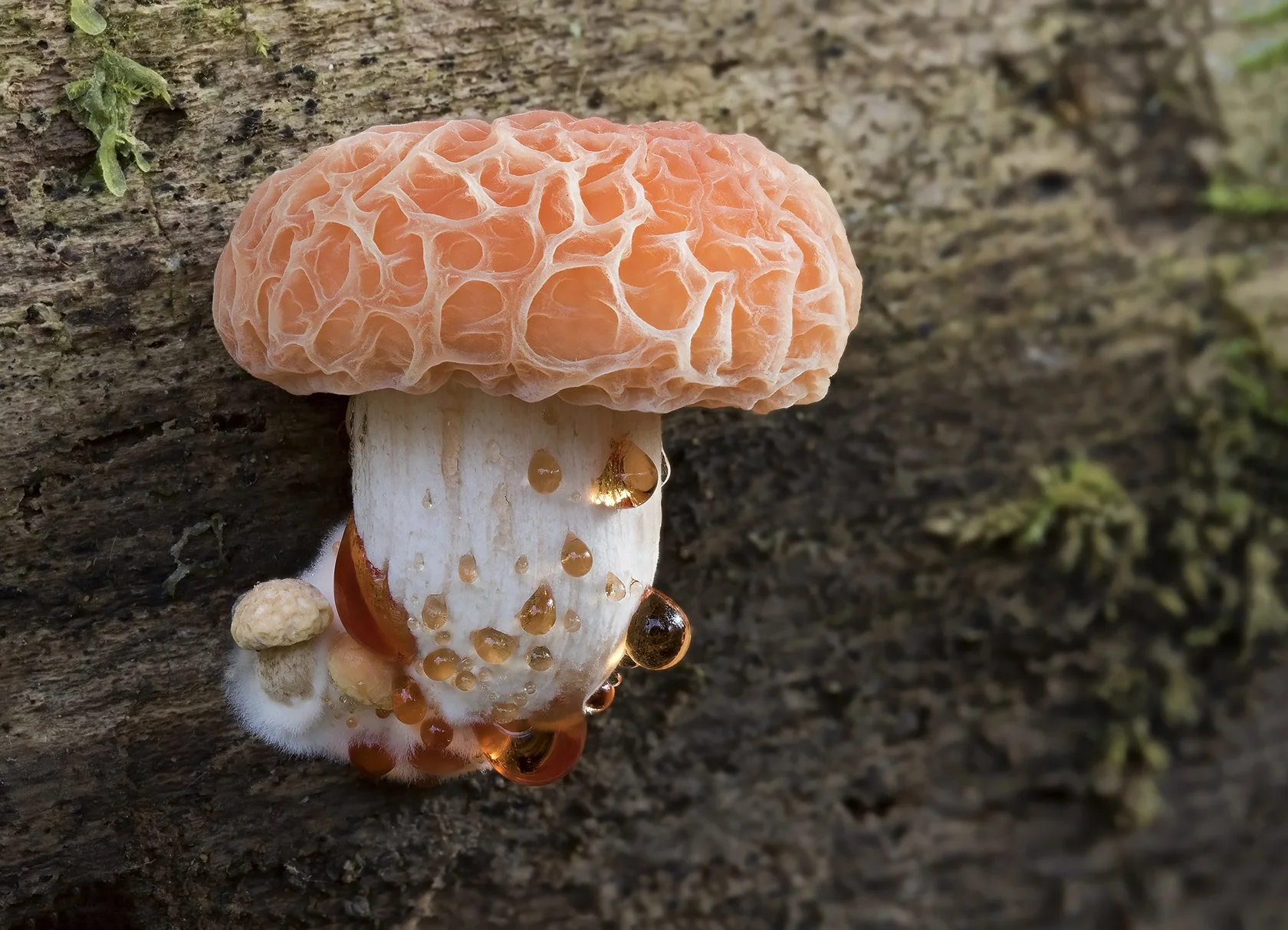
Ecologically, R. palmatus plays an important role in the decomposition of lignin-rich wood, contributing to nutrient cycling. It favours cool, shaded, and consistently damp environments, conditions that slow decay and allow it to develop its characteristic form. The fungus releases spores from pale, closely spaced gills, enabling it to disperse across fragmented habitats despite its overall rarity. Because it is sensitive to habitat changes, particularly the decline of elm trees, its presence is sometimes used as an indicator of woodland health.
Observing the Wrinkled Peach in the wild offers insight into the complexity of woodland ecosystems. Continued study of Rhodotus palmatus not only enriches knowledge of fungal diversity but also highlights the subtle dynamics of decay, regeneration, and species resilience. The stunning example above was found and photographed in a West Sussex woodland.
References:
Buczacki, S., Shields, C. and Ovenden, D. (2012). Collins Fungi Guide: The most complete field guide to the mushrooms and toadstools of Britain & Ireland. London: HarperCollins, p. 236, fig. p.237.
Phillips, R. (2006). Mushrooms. London: Pan Macmillan, p. 268, fig. a.
Sterry, P. and Hughes. B. (2009). Collins Complete Guide to British Mushrooms and Toadstools. London: HarperCollins, p. 152, fig. p. 153.
https://species.nbnatlas.org/species/NHMSYS0001496430 [Accessed, 11th December 2025].
https://www.first-nature.com/fungi/rhodotus-palmatus.php [Accessed, 11th December 2025].