Mediterranean stranger
Few people would expect to find a Mediterranean insect living wild on the Hampshire coast. Yet among the brambles of Hayling Island, the Corsican [Mediterranean] Stick-insect Bacillus rossius (Phasmatodea: Bacillidae), has quietly established one of Britain’s most fascinating, naturalised insect populations.
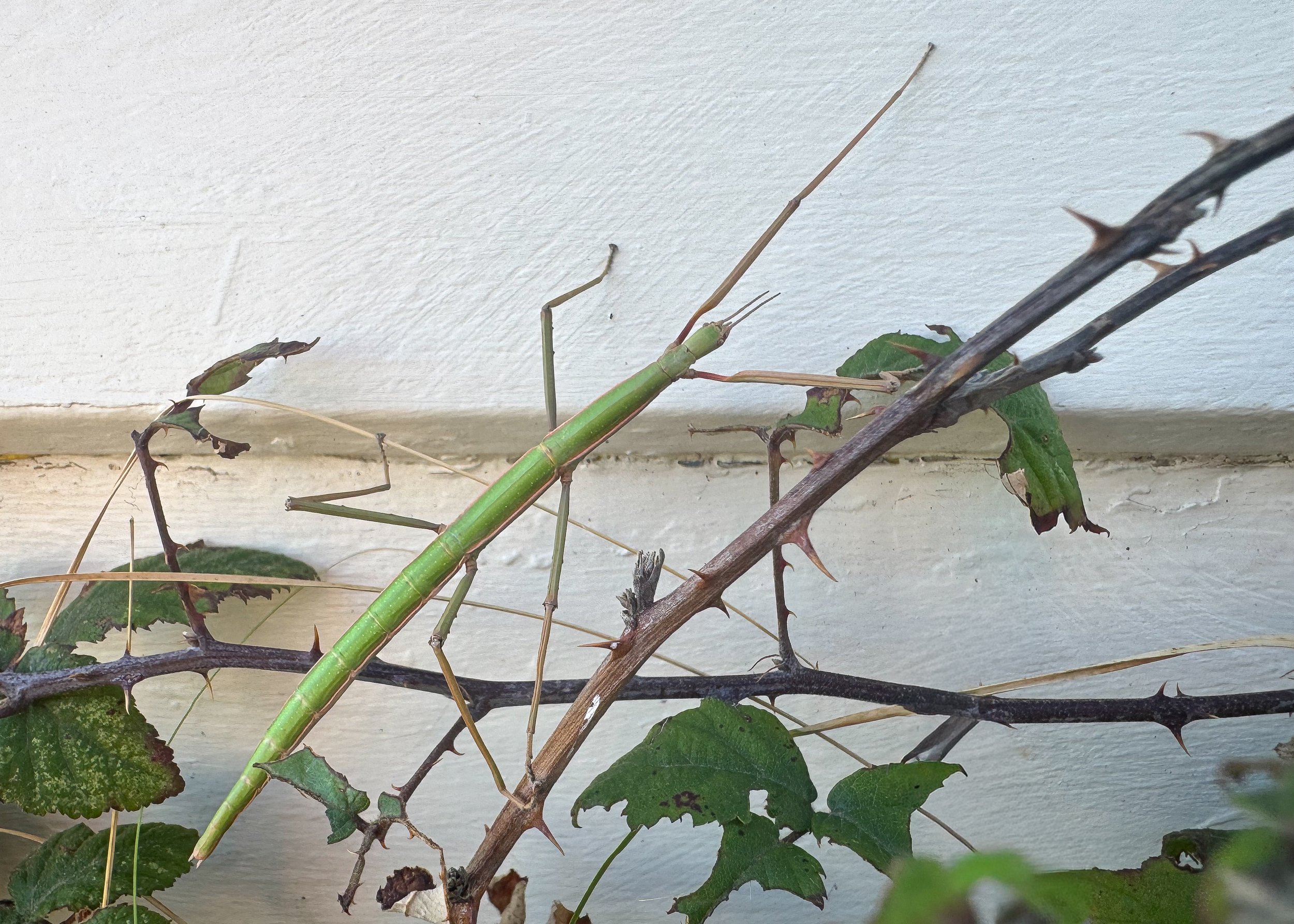
Bacillus rossius is long, slender and wingless, with adults reaching around 10 cm in length. Its green or brown colouration provides superb camouflage, allowing it to almost vanish among stems and leaves. By day, it is usually almost perfectly still; after darkness falls, it becomes active, climbing through the vegetation to feed.
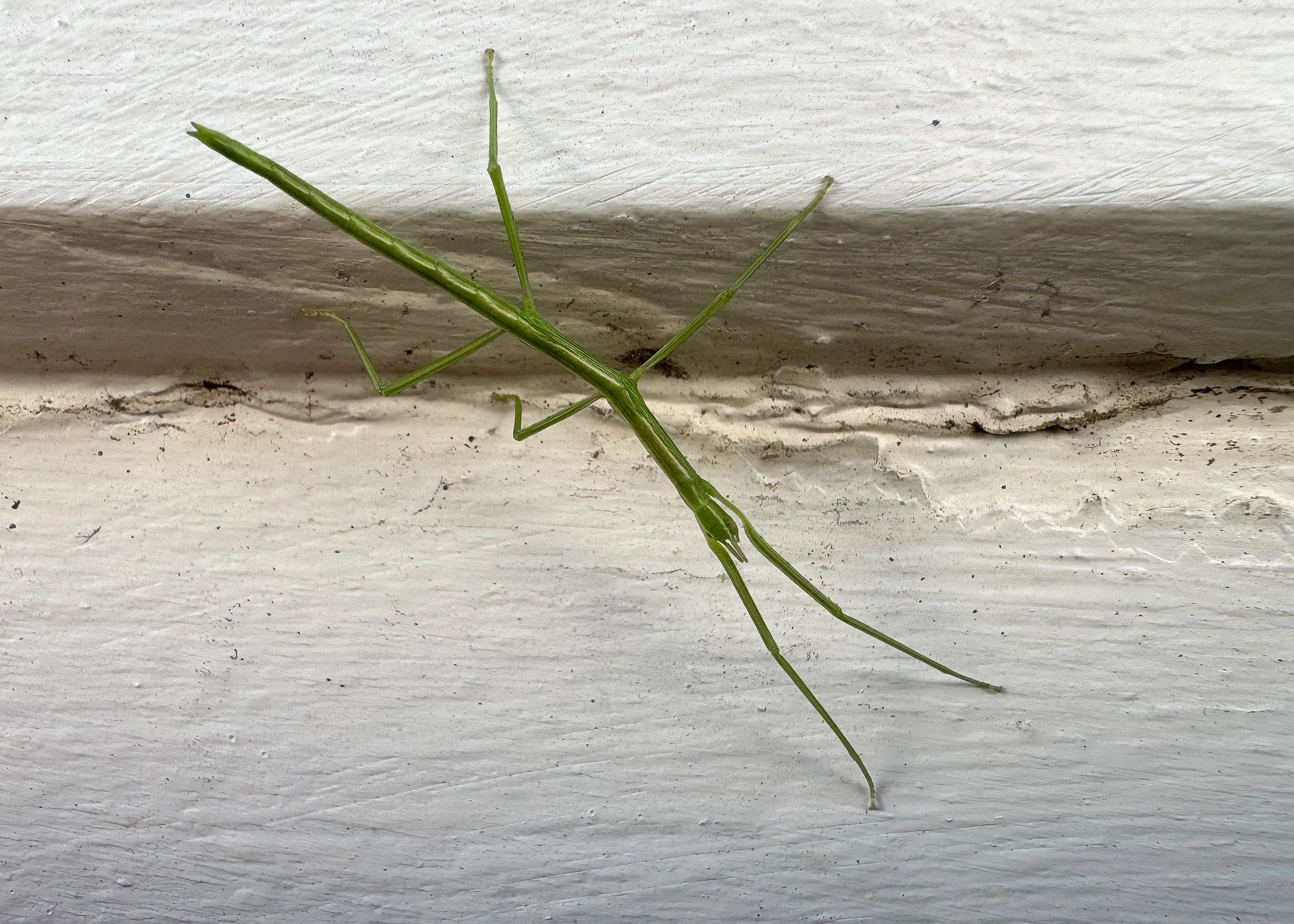
The Hayling Island population appears to have been present since at least 2009 and is centred around the south of the island, where dense bramble grows amongst the beach huts and adjoining areas. The habitat offers an intriguing explanation for its success. Although B. rossius originates from the warmer regions of southern Europe, the Hayling Island colony occupies a series of sheltered microclimates. Bramble provides both abundant food and cover, while the beach huts offer protection from strong coastal winds. On sunny days, their surfaces can become considerably warmer than the surrounding air, creating ideal places for the insects to absorb heat.
This combination of food, shelter and warmth may be more important than the general climate of the area. The colony illustrates how even a small, favourable microclimate can allow a species to survive far beyond the conditions normally associated with its native range.
Its reproductive biology provides another advantage. The British population appears to reproduce through parthenogenesis, meaning that females can produce offspring without mating. Eggs are simply dropped onto the ground beneath the food plants, where they can endure periods of unfavourable weather. The ability to overwinter as eggs is likely to be particularly important in Britain, where adult insects are likely to be vulnerable to prolonged periods of cold.
The Hayling Island colony is a reminder that Britain’s wildlife is never quite as settled as it might seem. Species arrive, establish themselves and sometimes discover unexpected opportunities in habitats we might otherwise overlook. Here, a few sheltered patches of bramble beside the beach have provided almost everything a Corsican [Mediterranean] Stick-insect needs to make a new home - thousands of miles from where its story began.
References:
Haes, E.C.M. and Harding, P.T. (1997). Atlas of grasshoppers, crickets and allied insects in Britain and Ireland. London: The Stationery Office. (ITE Research Publication No. 11), p. 52.
Sutton, P. and Beckmann, B. (2026). Field guide to the grasshoppers and allies of Great Britain and Ireland: Grasshoppers, crickets, earwigs, cockroaches, mantids and stick-insects. Illustrated by R. Lewington. London: Bloomsbury Wildlife, pp. 270-271, 302.
https://phasmidstudygroup.org/index.php/phasmids/uk-phasmid-sighting [Accessed, 13th September 2026].
https://species.nbnatlas.org/species/NHMSYS0001387264 [Accessed, 13th September 2026].