Mimicry …
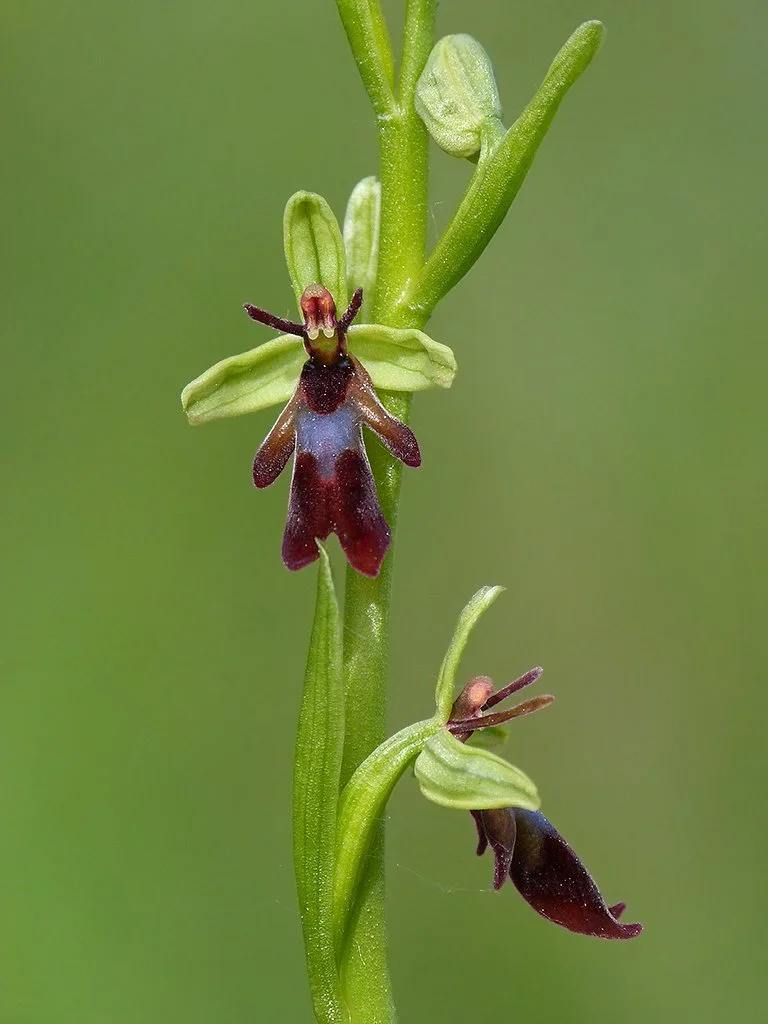
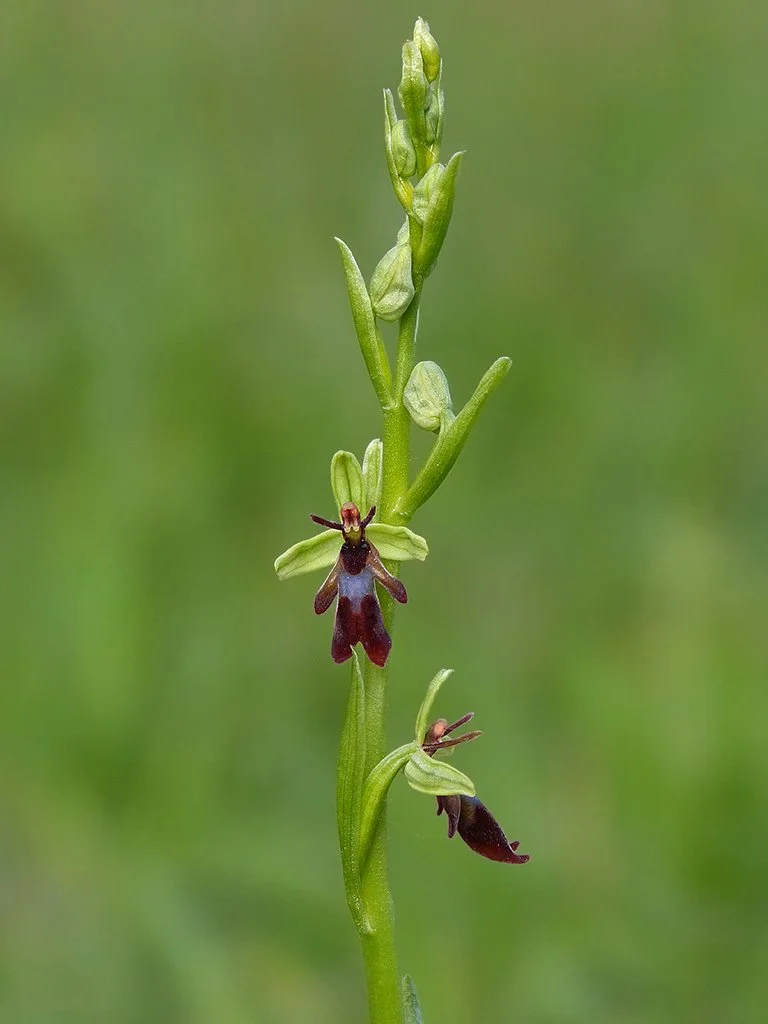
A number of orchid species use mimicry to attract their pollinators, shaping illusion into strategy. In these quiet negotiations between plant and insect, resemblance becomes language: colour, texture, even scent tuned with uncanny precision. Insect-mimicking orchids gain a singular advantage as they do not cast a wide net like generalists, but instead beckon to one chosen partner, narrowing chance into near certainty.
Among them, the Fly Orchid Ophrys insectifera stands as a master of deception. Its slender form and dusky petals evoke the body of a small fly, complete with the suggestion of antennae and the metallic sheen of folded wings. More than visual trickery is at play as the flower also emits chemical cues that mimic the pheromones of female insects, luring in males who attempt to mate with the bloom and unwittingly dusting themselves with pollen as they depart.
Flowering from late April to June, this elusive orchid favours unimproved calcareous grasslands, where chalk-rich soils sustain a delicate ecological balance. Within the South Downs National Park, it appears in scattered colonies, often overlooked unless one knows how to read the land closely, short turf, open sun, and soil undisturbed by heavy agriculture.
To find it is to witness a fleeting conversation between species, a small drama of mimicry and desire played out in miniature, where survival depends not on strength, but on the art of becoming something else entirely.
References:
Cole, S. and Waller, M. (2020). Britain’s Orchids - A field guide to the orchids of Great Britain and Ireland. Woodstock, Oxfordshire: Princeton University Press., pp. 238-239.
Lang, D. (2004). Britain’s Orchids. Old Basing, Hampshire: WILDGuides Ltd., pp. 146-147.