The Aurelians
The earliest recorded British occurrence of the Bath White Pontia daplidice has traditionally been attributed to William Vernon (fl. 1660–c.1735), who is reputed to have captured a specimen at White Wood, near Gamlingay, Cambridgeshire, in May 1702. The specimen long regarded as representing this first British record, a worn female, resides in the Hope Department of Entomology, Oxford University Museum of Natural History (OUMNH), having passed through the collections of James Petiver (1663–1718) and later James C. Dale (1791–1872). The year 1702 has frequently been cited as the date of capture (Ford, 1967; Howarth, 1973). However, available evidence suggests that this attribution is incorrect and that the OUMNH specimen represents a later acquisition. Despite this, it is still widely considered to be the oldest surviving pinned entomological specimen.
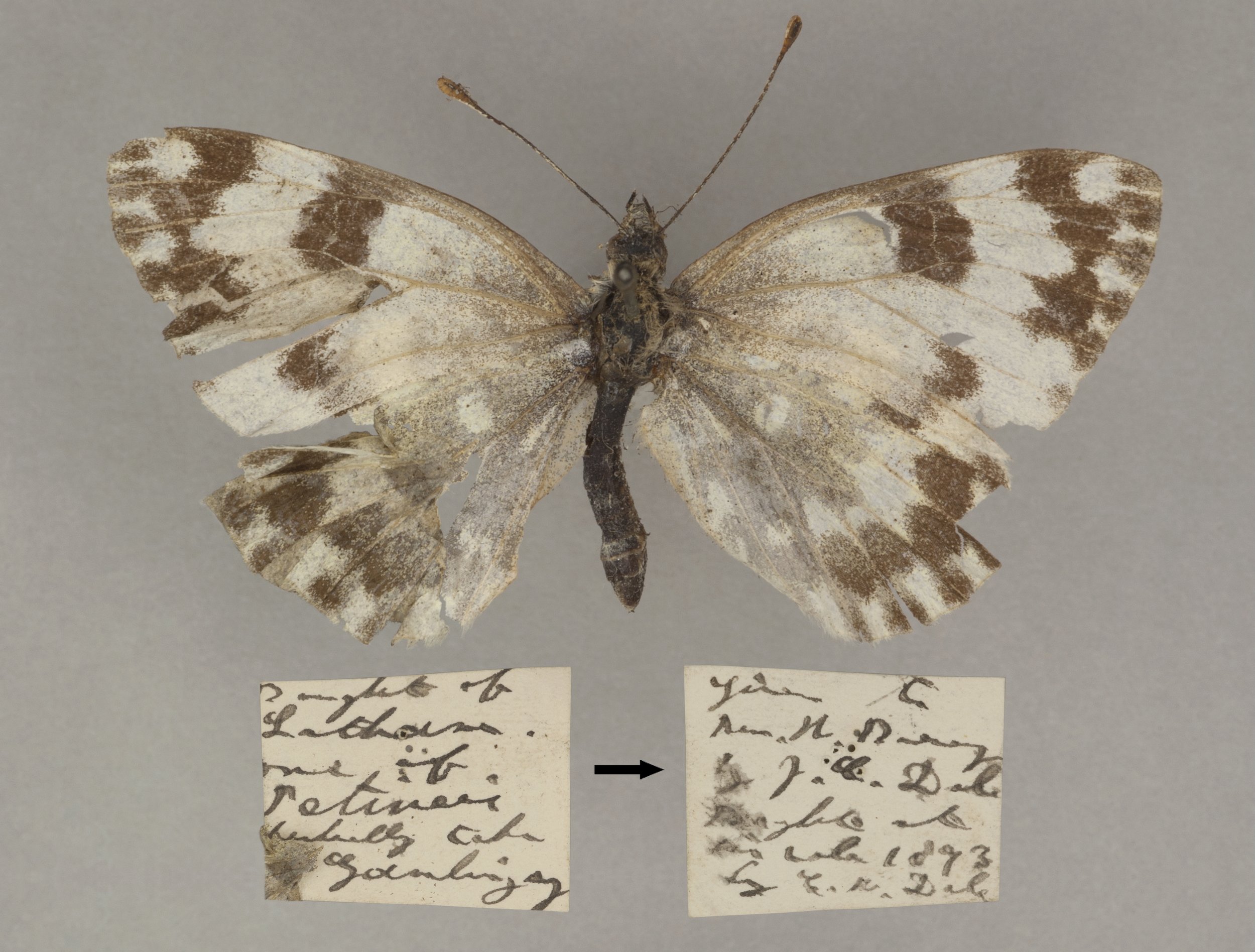
The original capture of the first British specimen must have occurred prior to 1699. In the fourth of his Musei Petiveriani Centuria [Petiver’s Museum: A Collection of One Hundred Specimens], completed on 31st August 1699 and published later that year, Petiver lists Papilio leucomelanus, subtus viridescens marmoreus [A black-and-white butterfly, with the underside marbled green] and records that “the only one I have seen in England Mr Will Vernon caught in Cambridgeshire”. This establishes 1699 as the latest possible date for the capture, with additional evidence indicating that it may have occurred in or before 1695.
The history of British Lepidoptera is inseparable from that of their collectors, and current knowledge is the cumulative result of more than four centuries of collecting and study. While modern attitudes towards collecting have changed, and although collecting alone is unlikely to have been the principal cause of species decline in most cases, it may have contributed to some local or historical losses under certain circumstances.
Entomological research continues to rely on the responsible collection of specimens. Although this is now less frequently required for Lepidoptera, it remains essential for many other insect groups where reliable identification depends on microscopic examination or DNA analysis. The retention of voucher specimens is also fundamental, allowing future verification and further study. This places an obligation on researchers to ensure the long-term preservation and accessibility of material beyond their own active involvement.
The unavoidable impact on some specimens, while regrettable, is an inherent part of professional entomological research. When undertaken with clear scientific purpose and with the aim of improving understanding and conservation, such practices are defensible. Collecting undertaken primarily for commercial gain or personal gratification, in the same way as perhaps a philatelist may with small squares of pristine coloured paper set neatly in rows in an album, cannot be justified and warrants critical evaluation.
References:
Ford, E.B. (1967). Butterflies. London: Collins (New Naturalist), pp. 9-10.
Howarth, T.G. (1973). South’s British Butterflies. London: Frederick Warne & Co, pp. 56-58.